
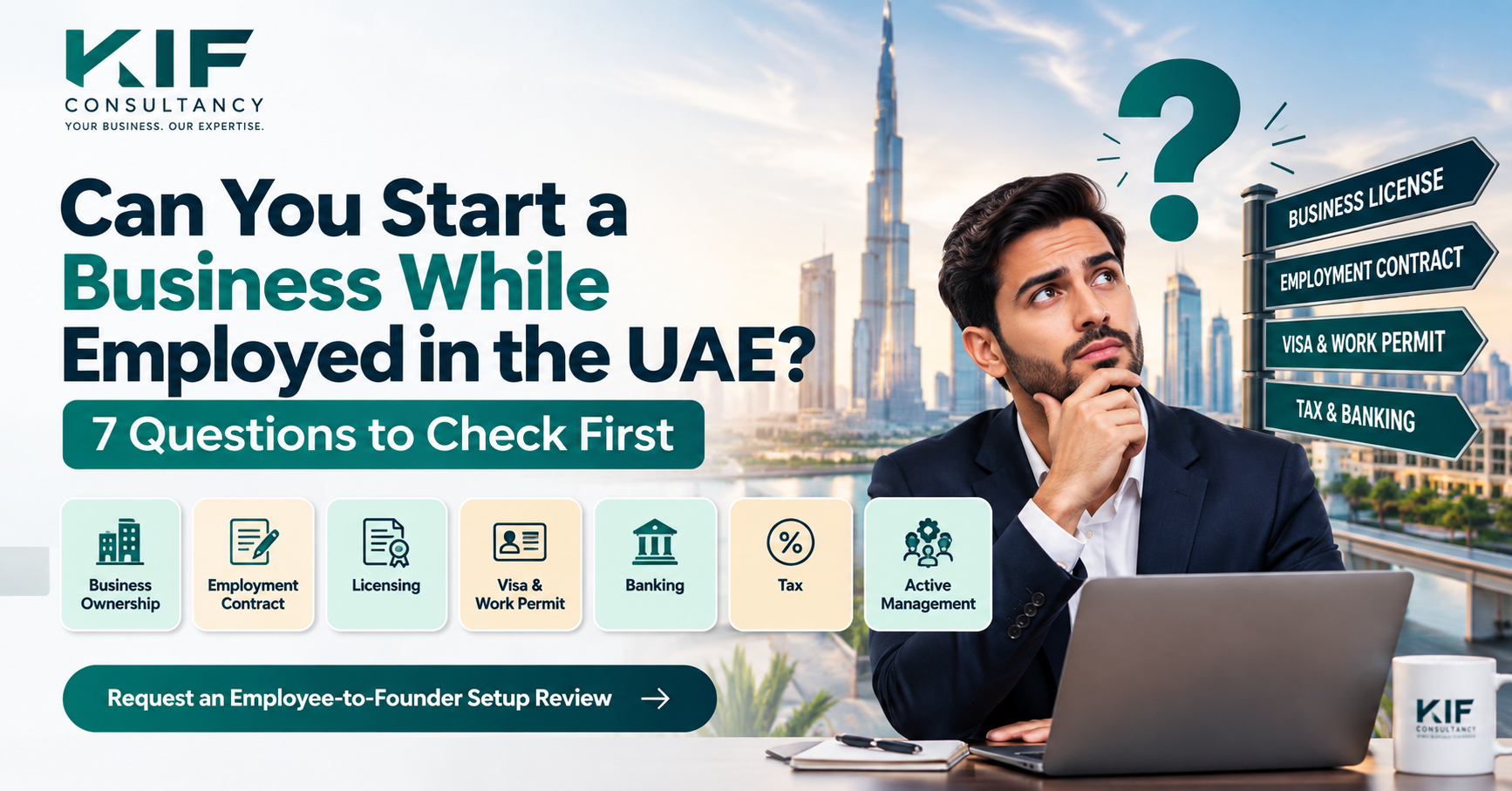
Imagine working a full-time job in Dubai while building your own business on the side. Perhaps you want to launch an e-commerce store, establish a consultancy, or turn a weekend project into a profitable company.
But one question keeps coming up: Can a UAE employee own a business while remaining employed?
The short answer is yes, in many cases. UAE employees can potentially own shares in a mainland or free zone company without resigning from their existing jobs. However, owning a business, actively managing it, and working for it are different activities with different legal and regulatory requirements.
Before applying for a trade licence, there are seven important questions every aspiring employee-founder should answer.
1. Can You Legally Own a Business While Employed in the UAE?
Business ownership and employment are not automatically incompatible in the UAE.
An employee may be eligible to establish a company or become a shareholder while maintaining existing employment, subject to the relevant licensing authority’s rules, their employment arrangements, and any applicable sector-specific restrictions.
For example, an accountant employed by a Dubai company might wish to invest in an online retail business. Simply holding shares in that business is different from personally providing accounting services to its customers.
Three important distinctions are:
- Ownership: Holding shares or investing in a company.
- Management: Making operational decisions, signing contracts, or directing company activities.
- Employment: Performing work for the business, potentially requiring separate work authorisation.
A trade licence or shareholder status does not automatically provide permission to undertake every operational role.
2. Does Your Employment Contract Allow You to Start a Business?
Your employment contract deserves attention before you register a company.
Some employment agreements contain confidentiality, conflict-of-interest, outside-work, or non-compete provisions.
Under Article 10 of UAE Federal Decree-Law No. 33 of 2021, non-compete arrangements may be enforceable subject to legal conditions and limitations. Not every non-compete clause is automatically valid or applicable.
Consider these examples:
- A marketing executive opening an unrelated clothing business may present a different conflict risk from opening a competing marketing agency.
- An IT professional providing services to their employer’s existing customers may face confidentiality or conflict concerns.
- An employee investing passively in an unrelated company may have fewer operational conflicts.
Practical tip: Review your employment contract, HR policies, confidentiality obligations, and any applicable non-compete restrictions before starting your business.
3. Do You Need an Employer NOC to Open a Company in Dubai?
An employer No Objection Certificate (NOC) is one of the most misunderstood requirements in UAE business setup.
There is no universal rule that every employed resident must obtain an employer NOC simply to own shares in a UAE company.
However, certain free zones, licensing authorities, regulated activities, and employment arrangements may require employer consent or supporting documentation.
Requirements can differ depending on whether you are:
- Registering a mainland company.
- Establishing a free zone business.
- Applying as a shareholder, manager, or authorised representative.
- Seeking additional work authorisation.
Important: A licensing authority not requiring an NOC does not automatically eliminate obligations under your employment contract.
Confirm the requirements with the relevant authority before paying incorporation fees.
4. Can You Keep Your Employment Visa While Owning a Business?
You may be able to retain your existing UAE employment residence visa while holding ownership in another company.
However, residency, company ownership, and permission to work are separate matters.
For example, an employee sponsored by a Dubai trading company might establish a free zone business without immediately switching to an investor residence visa, depending on the free zone’s requirements.
But personally working for another company may require appropriate authorisation.
The UAE government confirms that eligible employees can work for a second employer under a Ministry of Human Resources and Emiratisation (MOHRE) part-time work permit, subject to applicable conditions. Free zone employment arrangements may follow different procedures.
Before proceeding, verify your residence sponsorship, proposed management role, work-permit requirements, and the rules applicable to your existing employer.
5. Should You Choose a Mainland or Free Zone Business Licence?
Choosing the correct jurisdiction can influence your startup costs, permitted activities, office requirements, and future expansion.
| Mainland company | Free zone company |
|---|---|
| Suitable for many businesses serving the UAE market | Suitable for various consultancy, digital, and international business models |
| Licensed by the relevant emirate’s economic authority | Licensed by the selected free zone authority |
| Office requirements depend on activity and authority | Flexi-desk and shared-office options may be available |
| Some activities require additional approvals | Activities and permitted operations depend on free zone rules |
Neither structure automatically guarantees that an employed person can manage or work for the business.
KIF Consultancy can help compare mainland and free zone business setup options based on your proposed activity, employment circumstances, and operational requirements.
6. Can You Open a UAE Business Bank Account While Employed?
Obtaining a trade licence is only one part of establishing a functioning business. You also need to consider business banking.
Banks conduct independent Know Your Customer (KYC) and business due diligence checks.
They may request:
- Valid trade licence and incorporation documents.
- Passport and Emirates ID of relevant owners and signatories.
- Ownership structure and Ultimate Beneficial Owner information.
- Business activity details, expected transactions, and source of funds.
- Supporting contracts, invoices, or business plans.
- Evidence of business premises where required.
If you’re employed elsewhere, a bank may ask how your new business will be operated and who manages its daily activities.
Being employed does not automatically disqualify you from opening a business bank account. However, bank account approval is never guaranteed, and requirements vary between banks.
Preparing a consistent business profile can reduce avoidable documentation delays.
7. What Tax Obligations Apply to Your New Business?
A common misconception is that earning a salary means your additional business income is automatically exempt from tax.
In reality, the tax treatment depends on your business structure and activities.
UAE Corporate Tax
A UAE-incorporated company generally falls within the Corporate Tax framework, subject to applicable exemptions and reliefs.
For an individual conducting business personally, the Federal Tax Authority states that Corporate Tax applies when the combined turnover from relevant UAE business activities exceeds AED 1 million in a calendar year. Employment wages are excluded from this calculation.
The AED 1 million individual threshold should not be confused with the Corporate Tax obligations of a separately incorporated company.
VAT Registration
For UAE-resident businesses, mandatory VAT registration generally applies when taxable supplies and imports exceed AED 375,000 over the previous 12 months, or are expected to exceed that amount within the next 30 days.
Voluntary registration may be available from AED 187,500 under the relevant conditions.
Value Added Tax (VAT) Registration
Proper bookkeeping from the beginning helps business owners monitor these thresholds and prepare accurate tax records.
Can You Start a Business While Employed in the UAE?
Answer 7 quick questions to identify what you may need to check before launching your UAE business.
This tool provides general preliminary guidance only. It does not determine legal eligibility or replace professional advice. Requirements depend on your employment documents, business activity and relevant UAE authorities.
Why Choose KIF Consultancy for Your Business Setup?
Starting a business while employed should be an exciting step toward financial independence, not a source of avoidable compliance problems.
At KIF Consultancy, we help aspiring entrepreneurs understand their UAE business setup options and prepare for the practical requirements of launching a company.
Our services include company formation assistance, business bank account opening support, VAT and Corporate Tax services, bookkeeping, and ongoing business compliance support.
Whether you’re planning an online store, consultancy, or trading business, our team can help identify the relevant documentation and authority requirements before incorporation.
Ready to turn your business idea into reality?
Request an Employee-to-Founder Setup Review
Get guidance on your proposed business activity, licensing options, banking documentation, and tax obligations.
+971 58 121 3467
info@kifconsultancy.com
Visit KIF Consultancy
Frequently Asked Questions
1. Can I start a business in Dubai while working full-time?
Yes, in many situations. However, you must check your employment contract, licensing requirements, and whether your planned business activities require separate work authorisation.
2. Can a UAE employee own a business without an employer NOC?
Possibly. An NOC is not universally required for share ownership, but the licensing authority, employment terms, or specific activity may require employer consent.
3. Can I own a free zone company while on an employment visa?
Potentially, yes. Some free zones permit company ownership while the shareholder maintains employment-based residency. Confirm the specific authority’s requirements.
4. Can I manage my own company after office hours?
Working outside your normal employment hours does not automatically eliminate contractual restrictions or work-authorisation requirements. Your management activities must be assessed separately.
5. Can I open a business bank account without cancelling my employment visa?
It may be possible. Banks independently assess your company, ownership, authorised signatories, business activities, and supporting documentation.
6. Do I pay UAE Corporate Tax on my salary and business income?
Employment wages are generally outside UAE Corporate Tax. Business income may be subject to Corporate Tax depending on whether it is earned personally or through a company, applicable thresholds, and other tax rules.
Final Thoughts
Starting a business while employed in the UAE is possible for many professionals, but success begins with understanding the difference between owning a company and operating one.
Check your employment agreement, confirm licensing requirements, establish your visa and work-authorisation position, and prepare for banking and tax compliance.
With the right planning and professional support, you can move from employee to entrepreneur with greater confidence.